
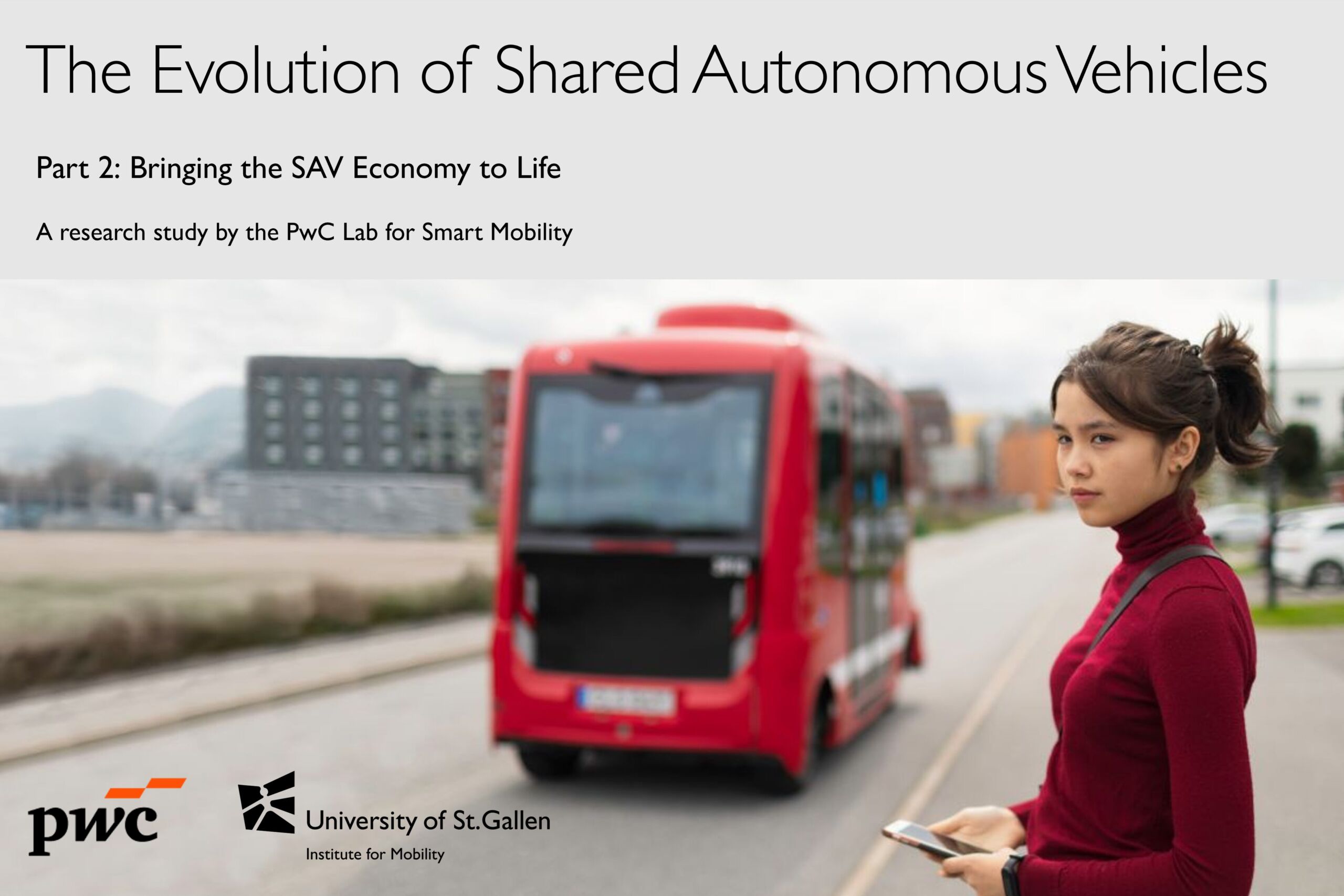
PwC Whitepaper: The Evolution of Shared Autonomous Vehicles (SAV) – Part 2: Bringing the SAV Economy to Life
Following the strong interest in Part 1 of our joint research with PwC, we are pleased to present Part 2 of The Evolution of Shared Autonomous Vehicles. While the first report focused on global market potential and user demand, the new study shifts to a central question: How can SAVs (robotaxis, roboshuttles and robobuses) successfully move from pilots to large-scale deployment?
Key Insights from Part 2
- From pilots to real-world operations: China and the US already operate millions of commercial robotaxi rides. In Europe, SAVs remain confined to small-scale pilots. The study outlines what is needed to close this gap.
- Economic potential for cities and operators: Our modelling shows that SAVs can significantly reduce operating costs, especially in public transport. Robust business and financing models could make future mobility more efficient and financially sustainable.
- Collaboration and regulatory clarity are essential: Scalable SAV deployment requires coordinated action with clear national regulations, strong partnerships between tech players and public transport agencies, and supportive political frameworks.
What this means for mobility?
Shared Autonomous Vehicles offer a major opportunity to reshape urban mobility and make it cleaner, more efficient and more accessible. With the right environment, SAVs can become a meaningful part of tomorrow’s transport ecosystem far beyond experimentation.
The study was part of a research project at the PwC Lab for Smart Mobility. Authors are Hartmut Güthner, Marvin Greifenstein, Peter Kauschke, Philipp Scharfenberger, Stefan Schorb, Felix Kuhnert and Andreas Herrmann.
Kontakt
Dr. Philipp Scharfenberger, philipp.scharfenberger@unisg.ch
PwC Whitepaper: The Evolution of Shared Autonomous Vehicles (SAV) – Part 2: Bringing the SAV Economy to Life
Following the strong interest in Part 1 of our joint research with PwC, we are pleased to present Part 2 of The Evolution of Shared Autonomous Vehicles. While the first report focused on global market potential and user demand, the new study shifts to a central question: How can SAVs (robotaxis, roboshuttles and robobuses) successfully move from pilots to large-scale deployment?
Key Insights from Part 2
- From pilots to real-world operations: China and the US already operate millions of commercial robotaxi rides. In Europe, SAVs remain confined to small-scale pilots. The study outlines what is needed to close this gap.
- Economic potential for cities and operators: Our modelling shows that SAVs can significantly reduce operating costs, especially in public transport. Robust business and financing models could make future mobility more efficient and financially sustainable.
- Collaboration and regulatory clarity are essential: Scalable SAV deployment requires coordinated action with clear national regulations, strong partnerships between tech players and public transport agencies, and supportive political frameworks.
What this means for mobility?
Shared Autonomous Vehicles offer a major opportunity to reshape urban mobility and make it cleaner, more efficient and more accessible. With the right environment, SAVs can become a meaningful part of tomorrow’s transport ecosystem far beyond experimentation.
The study was part of a research project at the PwC Lab for Smart Mobility. Authors are Hartmut Güthner, Marvin Greifenstein, Peter Kauschke, Philipp Scharfenberger, Stefan Schorb, Felix Kuhnert and Andreas Herrmann.
Kontakt
Dr. Philipp Scharfenberger, philipp.scharfenberger@unisg.ch